Passive Cooling
Accessories
Wearable clay accessories that lower body temperature through evaporative cooling — no energy, no electronics, no dependency. A material study exploring low-tech climate adaptation as a design response.
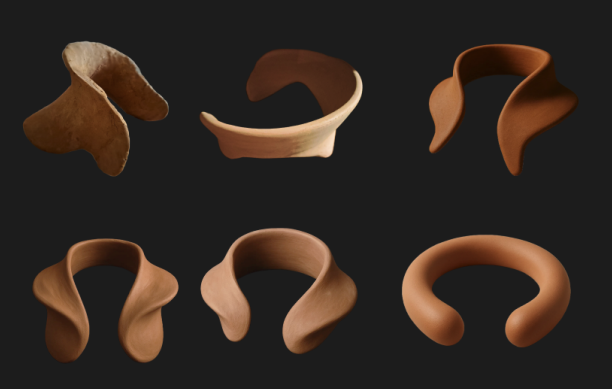 Add file: cooling-clay.png
Product photo or sketch of the clay pieces
Add file: cooling-clay.png
Product photo or sketch of the clay pieces
As temperatures rise across tropical regions, personal cooling has become a daily necessity — yet existing solutions rely on energy, refrigerants, or synthetic materials. What if cooling could be built into an object through material behaviour alone?
Clay has been used for millennia to cool water through evaporation. This study explored whether the same principle could be applied to wearable accessories — pieces worn against the body that release heat passively through moisture evaporation in porous ceramic walls.
The study focused on the thermal properties of unglazed porous clay — specifically the rate at which water evaporates through the ceramic wall and the resulting surface temperature drop. Variables tested included wall thickness, clay composition, and form factor.
Wearability constraints guided the form: weight, skin contact area, and how the piece is held or attached to the body. A wrist piece and a neck piece were developed as the primary forms — both positioned near pulse points where heat exchange is most efficient.
The pieces are designed to be soaked in water before use. As the water evaporates through the clay wall over several hours, the surface cools — creating a sustained low-energy cooling effect against the skin.